
BloomBaby Pregnancy Fitness Tracker
Tools Used
Overview
Personal Contributions

Defining the Problem
With our research insights and user group exploration takeaways, we determined that people are likely to cheat fitness trackers to resolve external goals, which can be unrealistic for pregnant women to consistently achieve.
User Group
Our team approached this project by narrowing down a distinctive user group, so that we could be specific and thorough with our research to develop features that address unique problems. After brainstorming on groups that may have particular fitness restrictions, we decided to focus our project on pregnant women and their health.
What is BloomBaby?
As a solution to pregnancy fitness struggles, we came up with BloomBaby. In order to motivate pregnant women through intrinsic incentives, not extrinsic, this fitness tracker:
- Prioritizes positive fitness habits, not arbitrary goals
- Educates people on pregnancy health
- Creates a safe space for pregnancy struggles
We determined that the goal of our solution was to maintain that good health and fitness means keeping up transparency.
Project Goals
- Empower users to become healthier by promoting behavior change through an improved understanding of the benefits of physical activity
- Foster sustained engagement with the tracker
- Reduce the likelihood of users falsifying data
Secondary Research
We began our project by conducting an online desk review focusing on what people should and should not do during pregnancy regarding health and exercise. We learned about why exercise is important to keep up during a pregnancy and how it can help with the health of both the mother and baby.
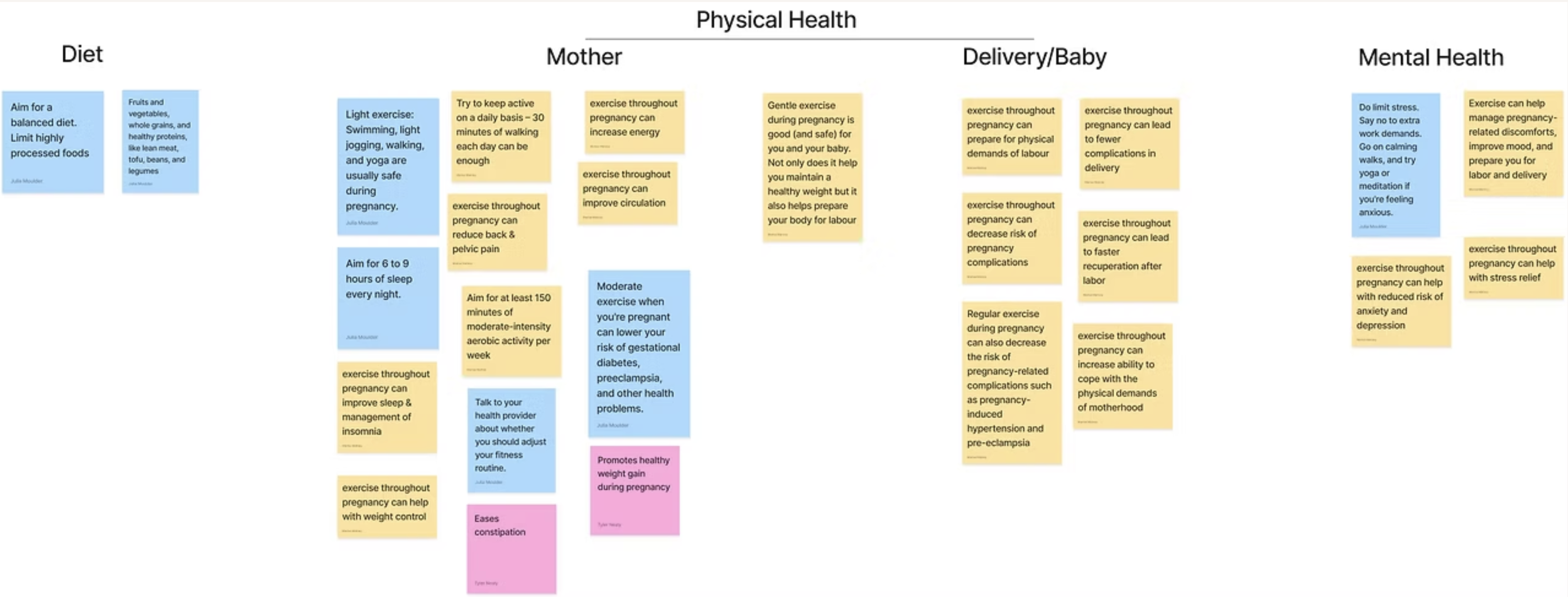
Our online desk review also yielded research articles about focus groups and interviews which aimed to discover why physically unfit pregnant women were struggling to keep up with healthy habits. We found that pregnant women often lost motivation to maintain their physical health for the following reasons:
- They feel unsure and uneducated about best health practices during pregnancy
- They are discouraged because they feel like they are failing their previous standards
- They feel like they are lacking support systems and a relatable community they feel comfortable sharing their struggles with
Interviews
After researching, we began interviews with people who are in our targeted user group or have been previously. We interviewed three mothers and one currently pregnant woman to gain an accurate representation of the mindset and struggles during pregnancy.
Some of the key questions we asked were:
- Would you say your exercise changed during pregnancy? How so?
- Did you track your fitness during pregnancy?
- Did you cheat your fitness tracker or be dishonest about your physical activity? Ex. shake arm back and forth Why?
- What were the challenges you faced towards being physically active?
- What motivated you to be active during pregnancy?
- What would’ve been the best way to motivate you to stay active?
- What would’ve been the best way to motivate you to stay active?
Some Key Takeaways:
- Interviewees were sick and tired for multiple weeks of the pregnancy
- Would’ve used a fitness tracker to keep her accountable
- Knowing that she would improve delivery would motivate her to stay active
Contextualizing Our User
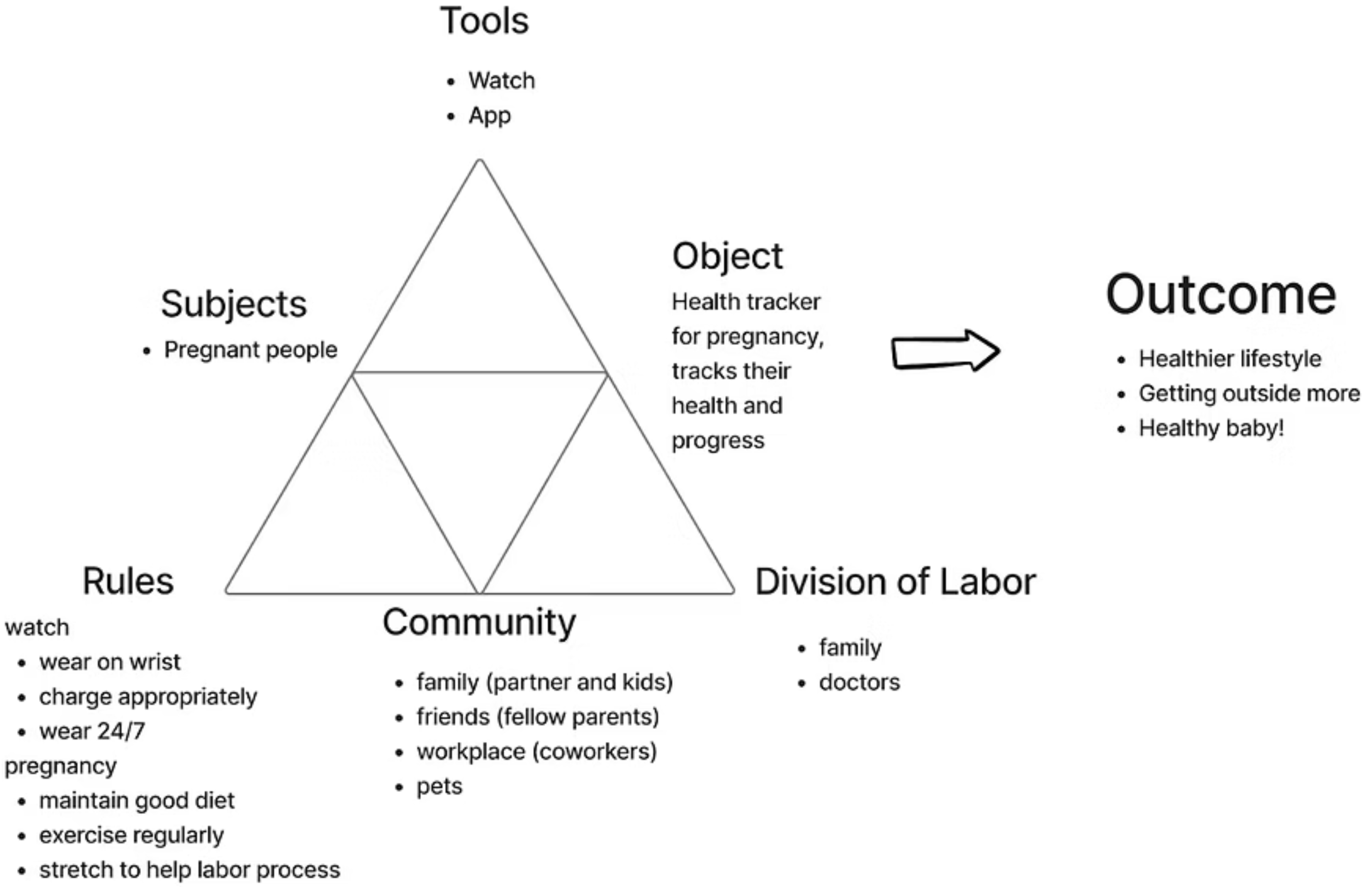
Activity Theory Diagram
Our activity theory diagram helped identify the characteristics and community regarding our target user group. We were able to use this to pinpoint specific pain points that led us to designing an app that addresses these issues. By focusing on who and what is interacting with pregnant women, we could better understand the whole problem scope.
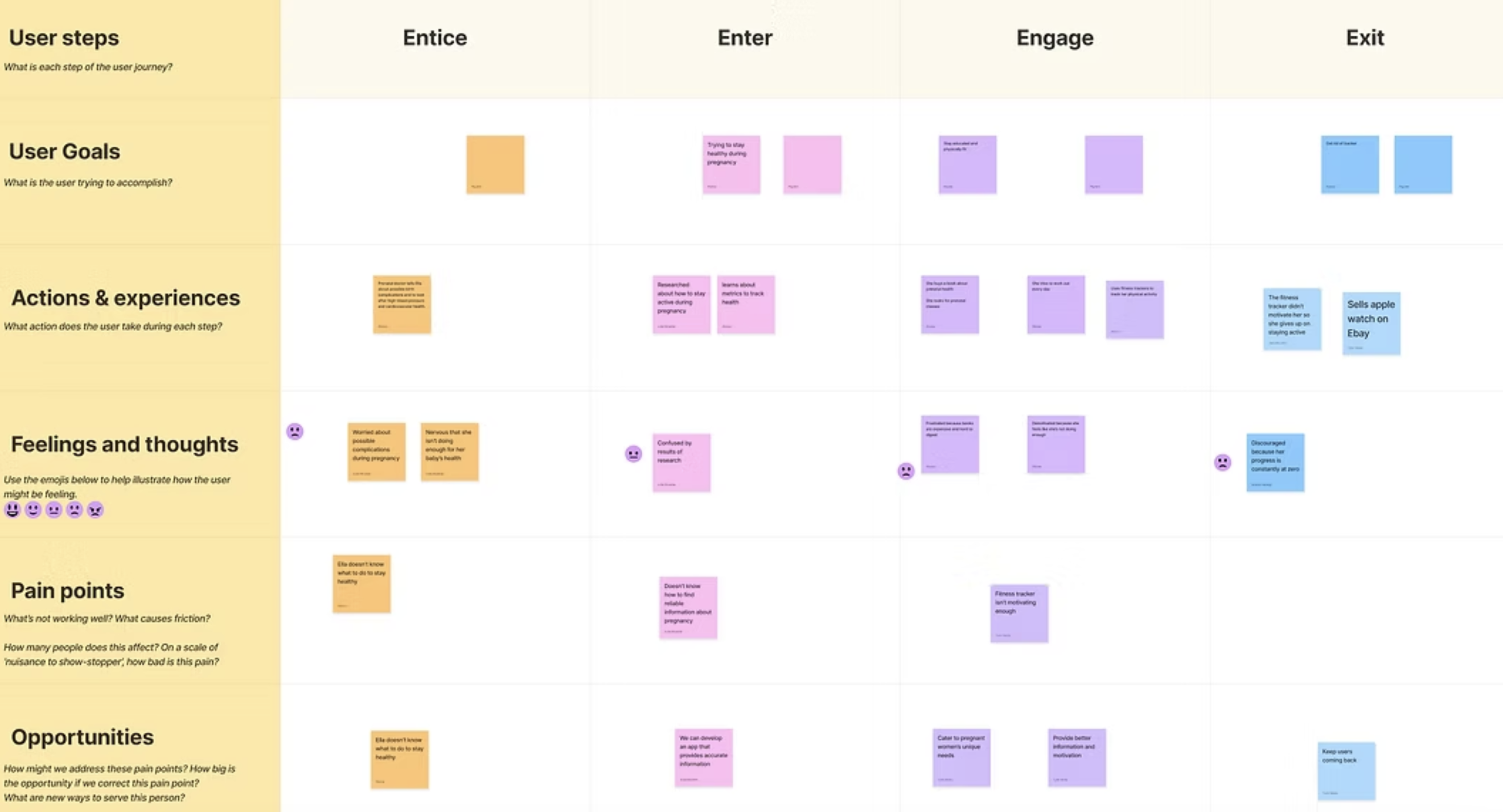
Journey Map
The journey map allowed us to focus on the thoughts and feelings of a user throughout the whole process of using a fitness tracker while pregnant. We found the positive and negative aspects of the user’s experience. By looking at the specific steps that the user struggled with, we could find lots of design opportunities to incorporate into our final prototype.
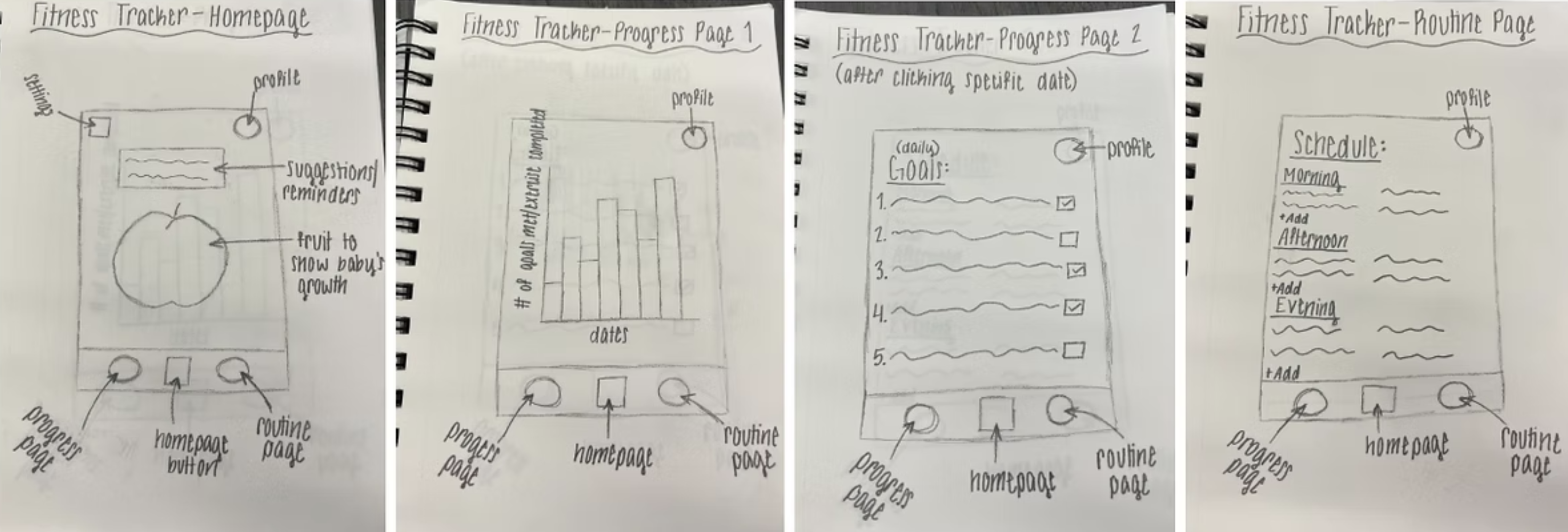
Sketches
We began iterating and sketching what our solution might look like. Individually, we came up with sketches for the app’s pages and features.
Mockups
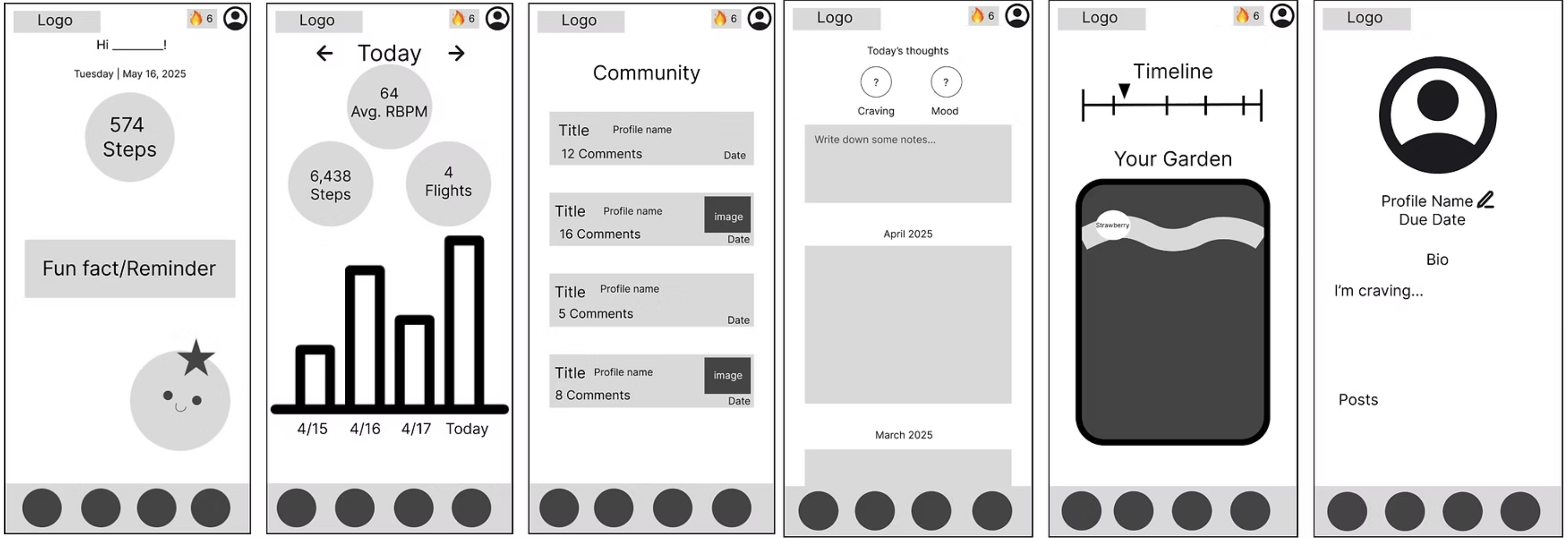
After completing our initial sketches, it was time to condense our ideas into higher fidelity mockups. To do this, we started by going over all of the sketches as a group and deciding on which aspects we liked best.
After aggregating the desired features, we designed low-fidelity mockups of each page and their features.
Final Designs

Usability Testing
The final step in our design process was usability testing of the app itself. We wanted to see if there were any pain points, confusing elements, and barriers that users face when interacting with the app. Another goal with these tests was to validate our design decisions. Using the prototype, we conducted four tests with former or currently pregnant women.
The goals of this testing were to:
- Assess the intuitive nature of the app’s design
- Determine if pregnant women feel like the app would be helpful
From this testing we learned the following:
- No clear call-to-action that prompts users to switch between days on Exercise History bar graph
- Poor visibility of Resources Page
- Some users would like a stronger onboarding process (I.E. introductory tutorial/walk-through)
Overall, users felt that the app’s theme is very strong and the features could be very helpful to pregnant people.
In further iteration of this product, we’d plan to implement this feedback through changing our app’s layout and including a tutorial or onboarding process for new users.
