
WalterPicks
Tools Used
Overview

What is WalterPicks?
WalterPicks is an AI-powered sports betting and fantasy sports app that allows users to make optimal predictions using personalized insights. Originally a fantasy sports platform, WalterPicks has more recently added betting features into the app, expanding its potential for user adoption.
Project Scope
Our scope for the project includes increasing shareability, user retention, and community for users. In completing the project, we would:
- Design prototypes for a new social feature for the WalterPicks mobile app
Project Phases

Desk Research & Competitive Analysis
Goals:
- Conduct research on multiple relevant sports betting related terms and apps
- Discover shareable features for bet tracking across multiple sportsbooks
- Identify competing apps that support features that foster in-app user-to-user engagement

Methodology:
- Reviewed discussions within the betting community to understand how bettors share information, strategies, and social dynamics
- Examined bet tailing to understand how users follow wagers and what influences trust, decision-making, and perceived expertise
- Conducted secondary research to identify recurring platform features, user motivations, and risks, as well as broader patterns in how social interaction shapes betting behavior
We also analyzed four bet-tracking apps and one community-focused, live-forum app to gather insights into how users interact while tracking bets.
Takeaways:
- Betting behavior is shaped by community discussion, shared picks, and reactions from other bettors.
- Observations from platforms like Discord show that bettors often seek validation, compare perspectives, and emotionally experience wins and losses together.
- Trending and popular picks increase bet conversion, drive engagement, and improve user retention.
Interviews
Goals:
- Understand the motivations behind sports betting and fantasy sports and the social context of sports betting and fantasy sports
- Identify pain points and design opportunities in the current space
Methodology:
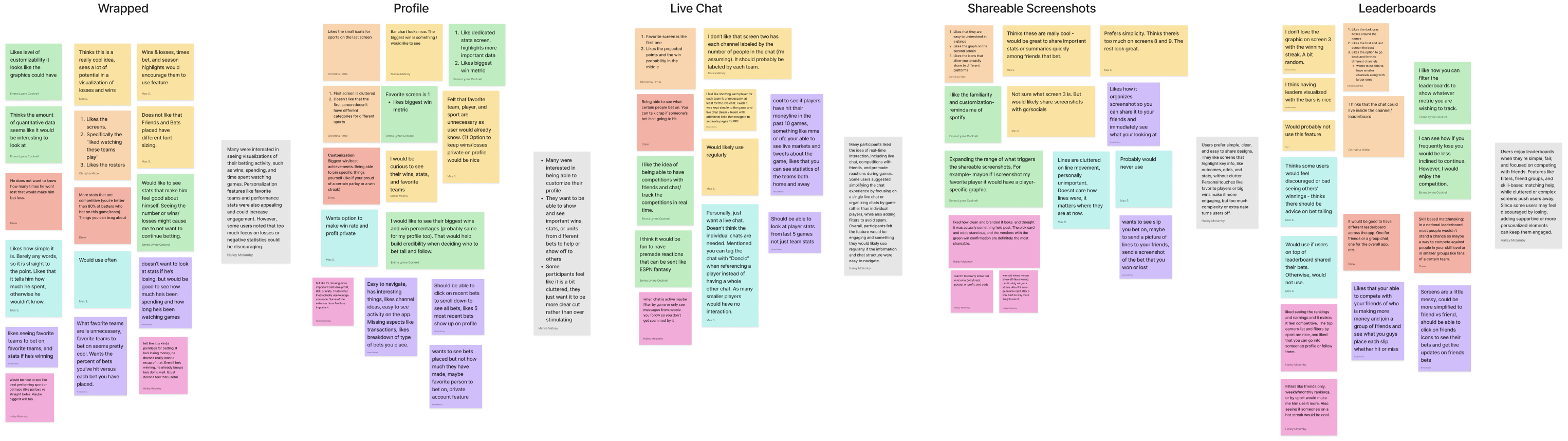
We reached out to various participants who are interested in or are actively sports betting. From the responses we gathered through our interviews we created an affinity diagram to gain a better understanding of what features will encourage greater interaction among the sports betting community.

Takeaways:
- Desire a larger community presence in sports betting that fosters more outreach and trust
- Motivated to engage in sports betting because it can make games more entertaining with potential profit
- Interested in seeing enhanced social features (private group chats, bet tailing, copy trading, and real time game discussion)

App Flow Analysis
Goals:
- Understand how users enter and navigate the current app flow
- Identify gaps in the current experience where social input or collaboration is missing
- Identify how social features could enhance confidence, engagement, and retention within the app
Methodology:
We mapped out the existing betting features and overall user journey, which provided a clear visual of key entry points and decision pathways within the app. We were able to identify opportunities where social features could enhance user confidence, engagement, and retention.
Takeaways:
- Clear and intuitive entry points improve navigation and drive user engagement and long-term retention.
- The current experience lacks elements that reinforce user confidence, especially when making betting decisions without social validation or insight from others.
- Though the features in the WalterPicks app are intuitive, they seem more geared toward a single-player experience than toward fostering user-to-user engagement.

Sketches
Goals:
- Foster engagement between users
- Keep users engaged with the app for longer periods
- Implement community-based messaging
Methodology:
We brainstormed and conducted a Crazy 8’s activity, which allowed us to throw out ideas that we might not have previously considered. We continued using the categories we had narrowed down from our competitive analysis and feature takeaways to ideate more.
Takeaways:
- We narrowed down initial sketches to five potential features to develop further in low-fidelity prototyping that we felt offered the strongest potential for shareability: Betting Wrapped, Shareable Screenshots, User Profiles, Live Chats, and Channels & Leaderboards
Personas & Journey Mapping
Goals:
- Create a persona of our ideal user to map the user's journey on the WalterPicks app before the implementation of new features
Methodology:
The created personas encompass key characteristics, user goals, needs, and pain points to help guide design decisions.
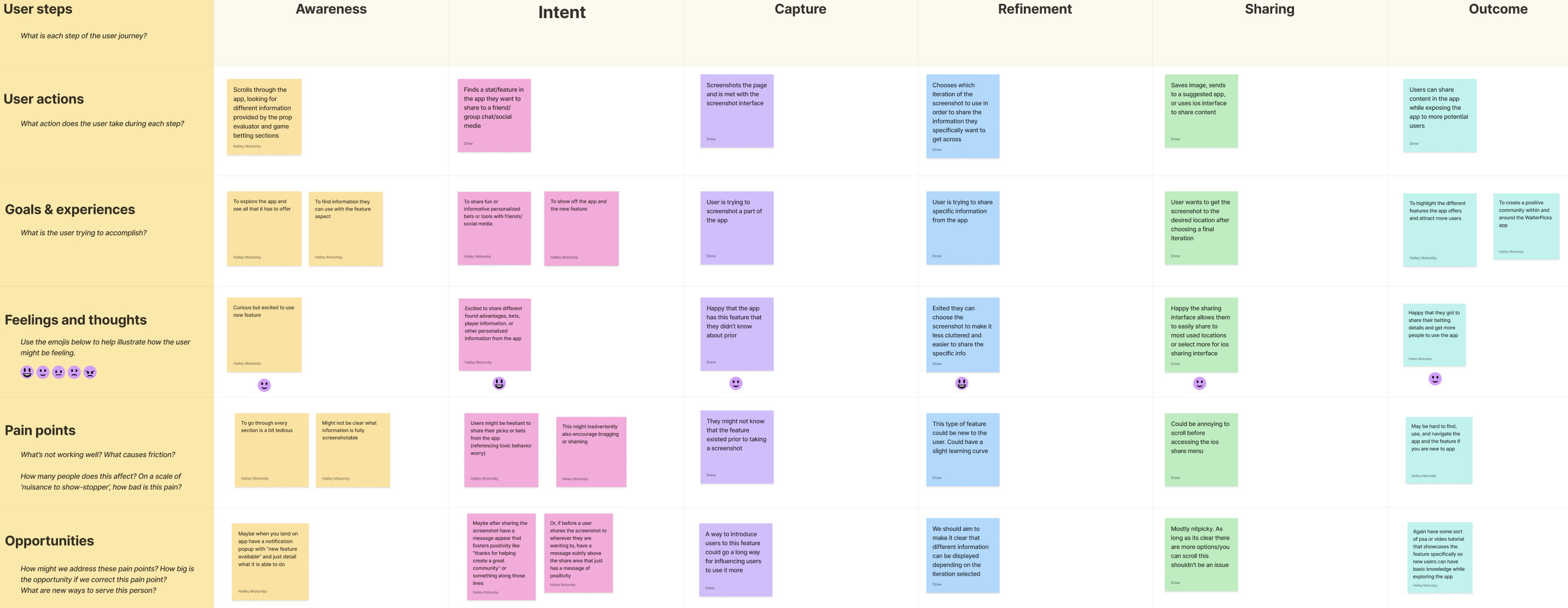
Using information gathered from the interviews and the created personas, we mapped the typical user journey using the WalterPicks app. We followed the user through downloading the app, onboarding, and making various betting decisions.

Takeaways:
- The current features of the app work well and as intended.
- A lot of users may leave the app in search of social features, such as messaging and live chats.
- With sports betting being a very saturated field, there needs to be more ways for the app to stand out and grow its user base.
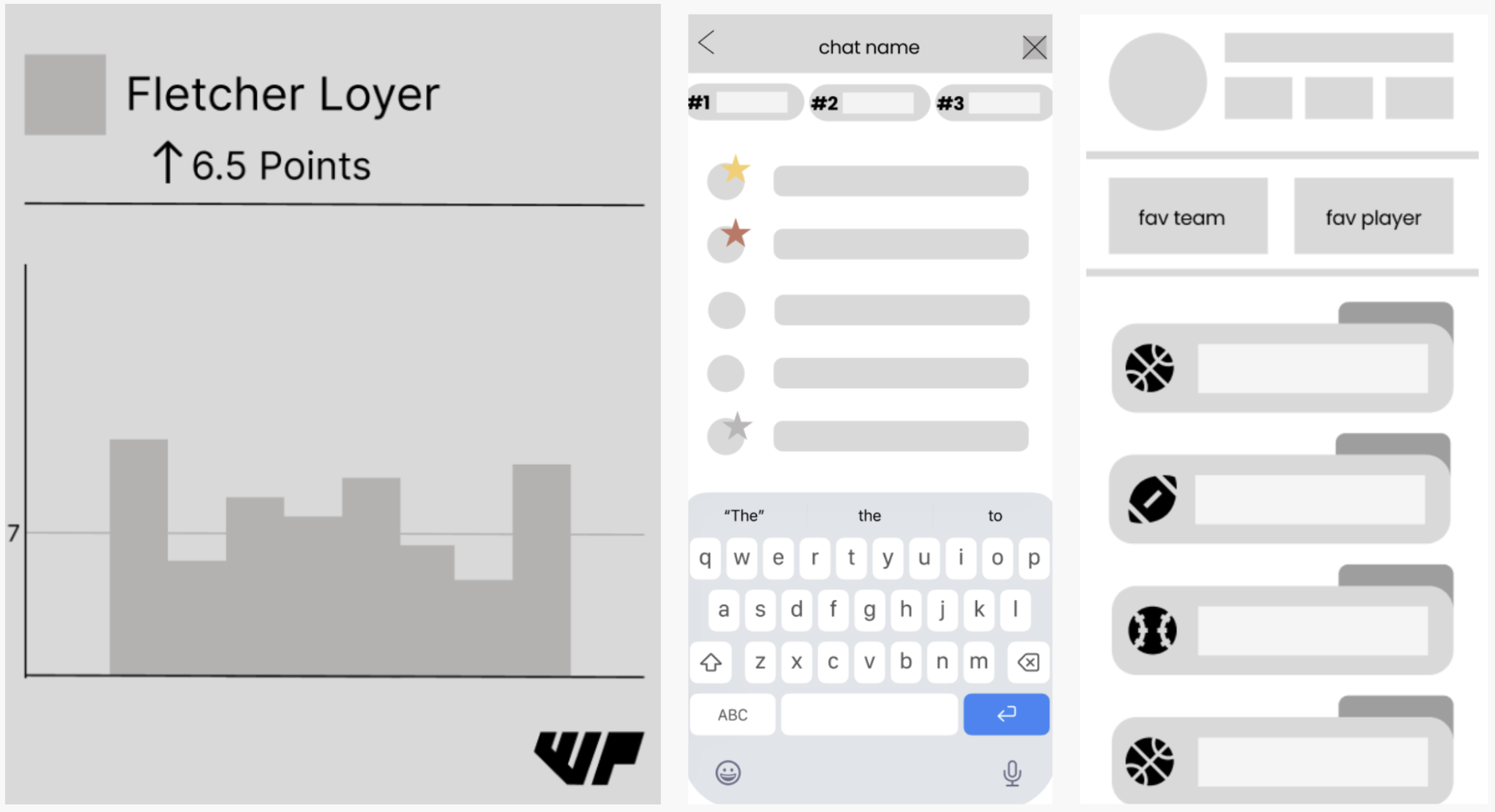
Low-Fidelity Wireframes
Goals:
- Create a visual blueprint of the interface, focusing on the placement of content, navigation, and hierarchy of elements
- Iterate ideas, identify usability issues, and plan the user experience
Methodology:
We created low-fidelity prototypes for each concept. Through internal discussions and sponsor feedback, we refined our ideas into three main directions. We then combined the strongest elements from our sketches and consolidated our findings to allow us to ideate for future prototypes.
Takeaways:
- Designers can understand layout and structure by seeing how content and navigation fit together.
- Designers can identify usability issues early before adding visuals or coding.
Concept Testing on Low-Fidelity Wireframes
Goals:
- Test low-fidelity designs with users to better understand pain points and areas of improvement
- Determine appeal to users and validate design decisions
- Identify strengths and limitations of prototypes to guide further iteration
Methodology:
For each of the five features, we asked participants to describe their thoughts, what they like, what they dislike, their ease of understanding, and how likely they would be to use the feature.
Takeaways:
- Participants wanted features to stay simple while having customization capabilities.
- Users feel discouraged when losing or being presented with negative statistics that highlight shortcomings.
- Shareable Screenshot feature received strong support from interview participants and sponsors with the possibility for quick integration into the app.
Mid-Fidelity Wireframes
Goals:
- Implement insights from concept testing of low-fidelity wireframes
Methodology:
Towards the beginning of designing our mid-fidelity wireframes, we decided to only move forward with the Shareable Screenshot feature. This feature is the easiest to implement, is the most versatile, and has the most iterations possible. We incorporated the features and feedback from our concept testing from our low-fidelity wireframes.

Takeaways:
- Focusing on the Shareable Screenshot feature for our prototypes will be ideal for improving the social aspect of the app based on support from our sponsors and interviews.
- From our mid-fidelity prototypes we were able to determine that some of our designs feel cluttered. We also used these prototypes to determine color choices and correct user flow.
High-Fidelity Prototypes
Goals:
- Build off of mid-fidelity wireframes to design high-fidelity mobile prototypes
Methodology:
Using our mid-fidelity wireframes, we were able to design high-fidelity prototypes of the Shareable Screenshot feature with the Prop Evaluator, Game Betting, Player Profile, and March Madness mobile pages.

Takeaways:
- Shareable Screenshots provide users a versatile new tool to share information with others through group chats, messages, and social media.
- Shareable Screenshots can increase attention to WalterPicks app through greater discoverability.
- Opportunities to expand features across more pages/sports, allowing more communities to use.
User Testing On High-Fidelity Prototypes
Goals:
- Understand how users will interact with new features and finalize prototypes based on feedback
- Identify areas of confusion or frustration with features
Methodology:
We conducted usability testing with participants who had experience with sports betting. We walked our participants through our Shareable Screenshot feature and had them verbally explain how they would navigate each screen. We asked questions about their first impression of the screen, screen clarity, any information they think is missing, and the overall usability.
Takeaways:
- Most users described the layout as self-explanatory and intuitive, noting that the simplified layout focuses on the most important stats without overwhelming the viewer.
- Participants want more "actionable" data, direct links to sportsbooks, and the ability to see specific team/player stats within the same view.
- Users love the ability to choose which category of stats to display and the visual consistency of the gradients across different screens.
Final Journey Map & User Flow
Goals:
- Map the user's journey on the WalterPicks app after the implementation of new features
- Combine information from the design decisions and research for the final version of social features
Methodology:
We mapped the user journey with the implementation of the Shareable Screenshot feature. We followed the user through downloading the app, onboarding, and making various betting decisions. This allowed us to better understand the user experience and ensure the new Shareable Screenshot feature flows nicely.
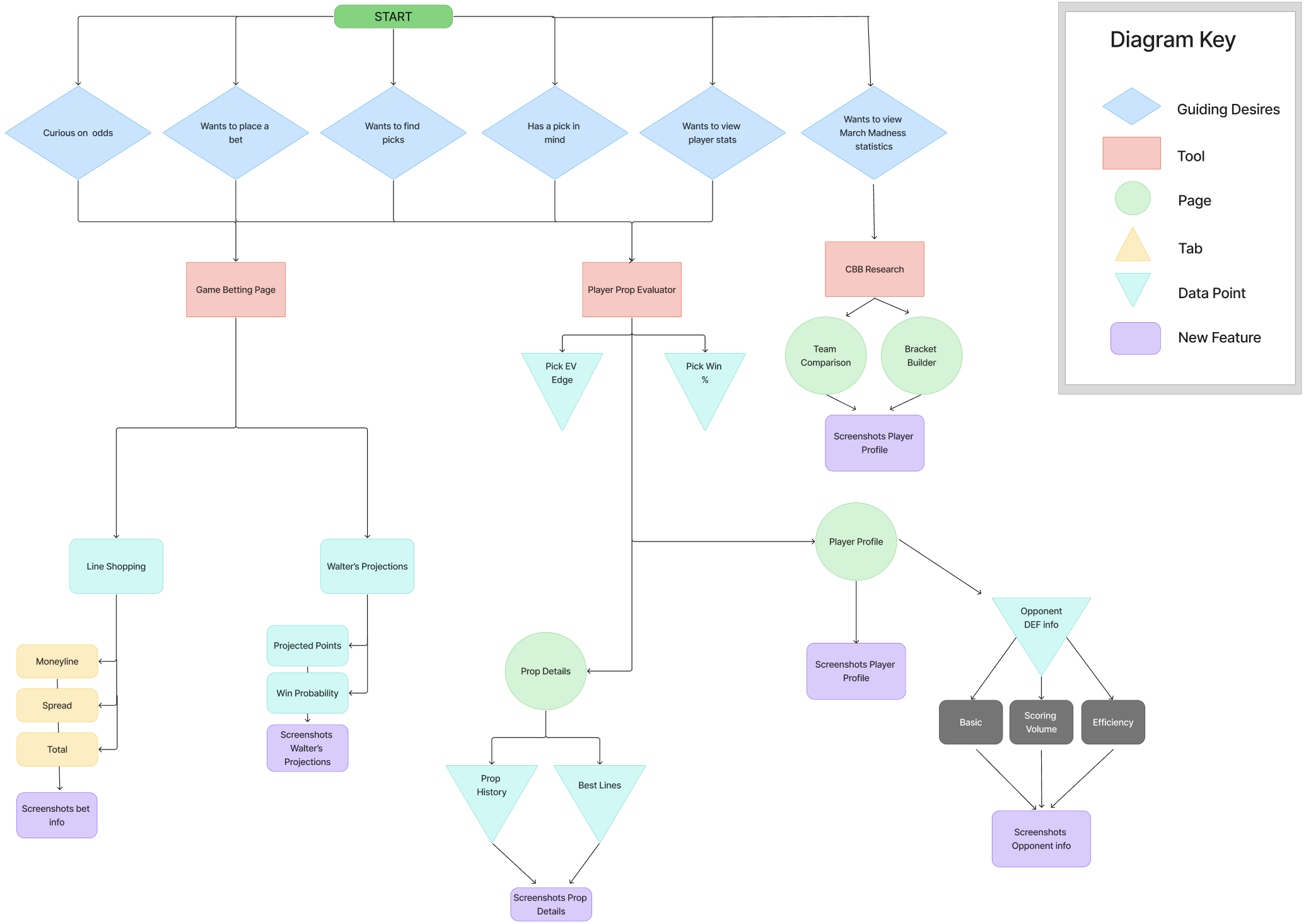
We expanded our initial App Flow Analysis to include the new Shareable Screenshot feature. We added new guiding desires for features that were newly released as we continued to work on the project. From our initial App Flow Analysis we identified the places where the screenshot feature should be available (Line Shopping pages, Player Profiles, Walter’s Projections, Opponent Information, and March Madness page)
Takeaways:
- There are potential places where the screenshot feature could be added in order to create a more cohesive and widely implemented feature.
- The screenshot feature connects analytical data points (research, comparisons) with outcomes, helping users show off their data backed betting decisions.
Final Deliverables
Personal Contributions
- Research: interviews, user testing
- Prototyping: sketches, low-fidelity wireframes, concept testing
- Documentation
Personal Reflection
I highly enjoyed working with the WalterPicks team this semester for my third Experience Studio project. Throughout the project, I had the opportunity to expand on my knowledge of UX research methods, Figma features, design strategies, and professional communication. A goal I had for this semester was to become more comfortable and knowledgeable about various UX Design concepts, and I feel this project provided me with the ability to build off of previous experience. I have improved in my ability to explain design decisions, document a project’s process, and design using Figma. I am also grateful to have had the chance to work with such a positive and supportive team. Sam and Dean were very easy to work with and provided insightful feedback that can be applied to future projects. Being on a strong, collaborative team allowed me to support my teammates while also strengthening my own skills. I appreciated the ability to balance mentoring others and deepen my own understanding throughout the process. Overall, I am very grateful to be a part of such an enjoyable project, and I am excited to see how the WalterPicks app will evolve.